

A Reflection from the Lens of NEP 2020 and Mathematics Education
“Mathematics is not about numbers alone; it is about thinking differently.”
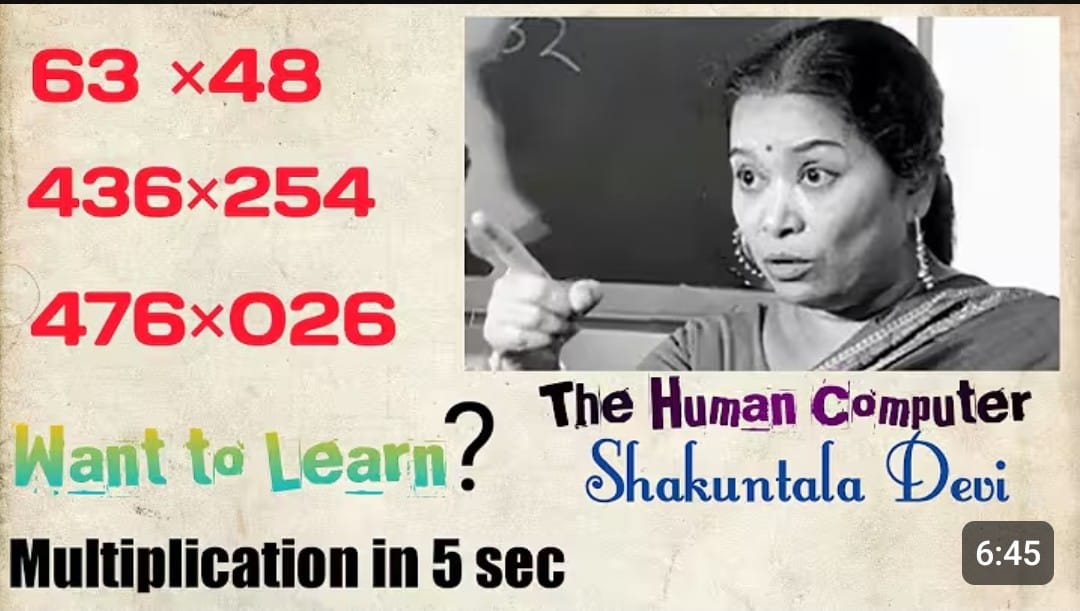
The inspiring movie Shakuntala Devi is much more than the biography of the celebrated “Human Computer.” It is a powerful reminder that Mathematics is a way of thinking, observing patterns, making connections, and solving problems creatively. For educators, students, and parents, the film offers valuable lessons that resonate with the vision of the National Education Policy (NEP) 2020 and the competency-based approach advocated by CBSE.
Shakuntala Devi’s extraordinary mental calculations were not the result of rote memorization but of deep conceptual understanding, exceptional number sense, and an innate ability to recognize patterns. Her performances across the globe demonstrated that Mathematics is a fascinating blend of logic, creativity, intuition, and imagination.
Mathematics Beyond the Textbook
The film challenges the common misconception that Mathematics is merely a collection of formulas and procedures. Instead, it portrays Mathematics as an enjoyable intellectual adventure. Every calculation performed by Shakuntala Devi reflects the power of observation, estimation, reasoning, visualization, and strategic thinking—skills that today’s Mathematics classrooms strive to cultivate.
As Mathematics teachers, our responsibility extends beyond helping students arrive at the correct answer. We aim to nurture learners who ask questions, justify their reasoning, identify patterns, and apply Mathematical concepts to real-life situations. This philosophy lies at the heart of NEP 2020.
Lessons for Mathematics Education
The movie inspires several classroom practices that can make Mathematics meaningful:
• Encourage multiple methods to solve the same problem.
• Develop strong number sense through Mental Mathematics activities.
• Promote Mathematical discussions instead of one-way instruction.
• Connect Mathematical concepts with everyday life.
• Build confidence by celebrating effort and logical thinking rather than speed alone.
• Integrate puzzles, games, investigations, and technology to make learning joyful.
These practices transform Mathematics from a subject of fear into a subject of exploration.
Connecting with NEP 2020
The film beautifully reflects the principles envisioned in NEP 2020:
• Experiential Learning: Learning by exploring patterns and discovering relationships.
• Competency-Based Education: Developing analytical and logical thinking instead of rote learning.
• Critical Thinking: Encouraging students to reason, justify, and innovate.
• Holistic Development: Recognizing that emotional well-being and intellectual growth go hand in hand.
• Joyful Learning: Creating curiosity and intrinsic motivation to learn.
A Message for Students
Every student may not become another Shakuntala Devi, but every student can become a confident Mathematical thinker. Mathematical ability is not a gift reserved for a few—it grows through curiosity, regular practice, perseverance, and the courage to make mistakes.
Instead of asking, “Is this the correct answer?”, students should begin asking, “Why does this method work?” and “Can I solve it differently?” Such questions develop true Mathematical understanding.
A Reflection for Teachers
The movie reminds us that an inspiring teacher can transform the way students perceive Mathematics. When classrooms encourage inquiry, collaboration, creativity, and joyful participation, learners begin to appreciate. Mathematics as a powerful tool for understanding the world.
Technology, Artificial Intelligence, Mathematical games, Real-life applications, and Interdisciplinary projects can further enrich this journey, making Mathematics meaningful and relevant for every learner.
Conclusion
Shakuntala Devi is more than a biographical film—it is a celebration of the limitless potential of the human mind. It reminds us that Mathematics is not about memorizing formulas but about discovering patterns, making logical connections, and enjoying the beauty of numbers.
As educators, let us strive to create classrooms where curiosity replaces fear, understanding replaces memorization, and every child believes, “I can think Mathematically.” That will be the true tribute to the remarkable legacy of Shakuntala Devi.
“When Curiosity meets Confidence, Mathematics becomes a joyful journey rather than a Challenging Destination.”
Mrs. Savitri Dhayal
HOD Mathematics


Leave a Reply